
Dark Mode


ER Wait Time and Patient Outcomes Simulation
Patient Health Records & Digital Health
Tags and Keywords
Trusted By



"No reviews yet"
Free
About
Data provides a realistic simulation of patient visits within an emergency room environment, drawing inspiration from real-world dynamics and published healthcare industry reports. It reflects insights gathered from studies on ER wait times, patient outcomes, and patient satisfaction metrics. Key factors such as urgency levels, seasonal trends, and time-of-day variability are incorporated into the simulation. This resource serves as a practical tool for learning data analysis, visualization, and statistical modelling in the context of healthcare operations.
Columns
The dataset focuses on 10 descriptive features selected from a total of 19 available columns:
- Visit ID (5,000 unique visit identifiers)
- Patient ID (5,000 unique patient identifiers)
- Hospital ID (5 unique hospital codes, with one ID representing 20% of the records)
- Hospital Name (5 unique hospital names, Riverside Medical Center being a common example, at 20%)
- Region (Categorised into Urban, accounting for 60%, and Rural)
- Visit Date (The date of the patient's visit, spanning 1 January 2024 to 31 December 2024)
- Day of Week (7 unique days, Monday is the most frequent at 15%)
- Season (4 unique seasons, with Summer at 26% and Winter at 25%)
- Time of Day (5 unique categories, Evening is the most common at 35%)
- Urgency Level (4 unique levels, Medium at 26% and High at 25% are the most common)
Distribution
The data is structured as a CSV file named ER Wait Time Dataset.csv, approximately 770.27 kB in size. It contains 5,000 records, representing simulated patient visits. The dataset was specifically designed using a Python-based simulation program to ensure logical relationships between the variables and align with domain knowledge.
Usage
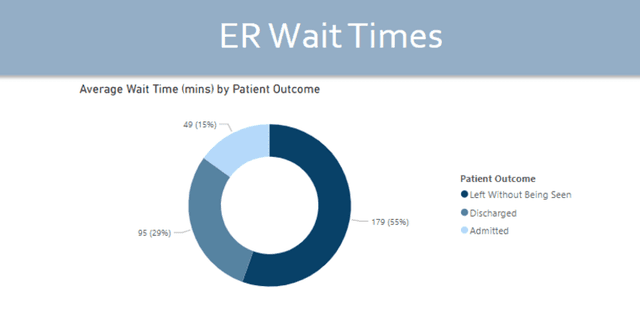
Ideal applications include learning statistical modelling and data visualization techniques within the healthcare sector. The data can be used to investigate operational efficiency by analysing how different factors—such as region or time of day—correlate with outcomes or patient wait times.
Coverage
The temporal scope spans an entire year, covering visits from 1 January 2024 to 31 December 2024. Geographically, the data is distributed across 5 unique hospital entities and segregated into Urban and Rural regions (60% Urban). Seasonal variability is well represented across the four seasons.
License
CC BY-SA 4.0
Who Can Use It
The dataset is highly useful for data scientists practising operational analytics, students seeking practical application in statistical analysis, and healthcare managers interested in simulation-based process improvement.
Dataset Name Suggestions
- Simulated ER Dataset: Wait Times, Outcomes, and Patient Satisfaction
- Healthcare Operations Simulation Data
- Patient Flow and Wait Time Analysis Metrics
Attributes
Original Data Source: ER Wait Time and Patient Outcomes Simulation
 QUALITY
Loading...